

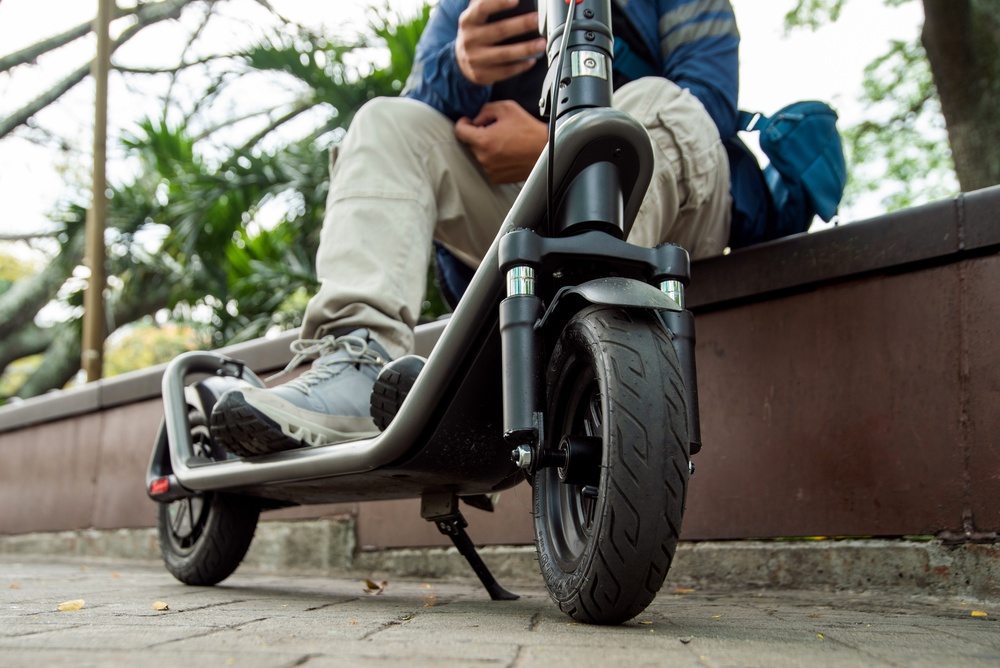
Walk through downtown Toronto and you will probably see both e-bikes and electric kick-scooters. That can make the legal rules seem obvious: if people are riding them everywhere and stores are selling them, they must be legal.
That assumption is wrong.
As of October 2026, electric kick-scooters are not legal to operate on Toronto public roads, bike lanes, cycle tracks, sidewalks, trails, paths, or parks. E-bikes, by contrast, can be legal in Toronto, but where they may be ridden depends on the type of e-bike and whether it actually meets Ontario’s legal requirements.
E-Scooters Are Not Legal to Ride on Toronto Public Property
Toronto has taken a clear position on electric kick-scooters.
The City states that e-scooters are not permitted on any Toronto public street. They also cannot be left, stored, or parked on public property.
Why? Ontario created a provincial e-scooter pilot program that lets municipalities decide whether e-scooters may be used within their boundaries. The current pilot runs until November 27, 2029. A municipality that wants to allow e-scooters must pass a by-law permitting their use.
Toronto has not done so.
That means seeing other people riding e-scooters downtown does not make the activity legal.
But Stores Sell E-Scooters in Toronto
This is a common source of confusion.
A person can buy an e-scooter from a Toronto retailer or order one online. That does not create a right to ride it on the Street, a bike lane, or a public trail.
The City regulates operation in public spaces; it does not simply ban retailers from selling the devices. Toronto expressly notes that e-scooters may be sold even though they cannot legally be operated in public spaces. They may potentially be used on private property with the owner’s permission, but purchasing one does not make it street legal.
What Counts as an E-Scooter?
Ontario’s pilot defines an electric kick-scooter as a vehicle with two wheels, a standing platform between them, a steering handlebar, and an electric motor not exceeding 500 watts that provides a maximum speed of 24 km/h.
The pilot also regulates matters such as brakes, lights, weight, rider age, and helmets. Those rules apply in participating municipalities; they do not make e-scooters legal in Toronto.
E-Bikes Are Different
A legal e-bike, generally called a “power-assisted bicycle” under Ontario law, is treated differently.
Ontario’s current requirements include a maximum assisted speed of 32 km/h, a motor not exceeding 500 watts, operable pedals, specified wheel dimensions, two independent braking systems, and a maximum weight of 120 kilograms. Riders must be at least 16 and wear an approved bicycle or motorcycle helmet.
The bike also cannot be modified beyond the permitted power or assisted-speed limits. Having two wheels, pedals, and a battery does not automatically make it a legal e-bike.
Where Can a Pedal-Assist E-Bike Be Ridden in Toronto?
Toronto generally permits pedal-assist e-bikes that require pedalling in the same types of cycling spaces used by conventional bicycles.
The City states that these bicycles may be used in painted bike lanes, physically separated bikeways, and multi-use trails, subject to posted restrictions and other applicable rules.
Sidewalks are different. Toronto generally allows sidewalk cycling only for riders aged 13 and younger, while pedal-assist e-bike riders must be at least 16. In practical terms, e-bike riders should not be using Toronto sidewalks.
What About Throttle-Controlled E-Bikes?
This area is more complicated.
Some e-bikes provide assistance only while the rider pedals. Others can move using a throttle, and some throttle-controlled devices look more like mopeds or motorcycles.
A throttle does not automatically make a vehicle illegal under Ontario’s current framework. Toronto, however, distinguishes between pedal-assist bicycles and throttle-controlled electric mopeds when deciding where they may be used.
The City states that pedal-assist e-bikes that require pedalling may use protected bikeways and multi-use trails. Throttle-controlled electric mopeds that do not require pedalling are treated differently and are restricted to roads, subject to applicable provincial requirements.
That distinction means the word “e-bike” is not enough to determine where a vehicle can legally travel.
If It Looks Like a Motorcycle, Different Rules May Apply
A vehicle marketed as an “e-bike” may actually fall outside Ontario’s power-assisted bicycle definition.
A high-powered or heavily modified device may instead qualify as another kind of motor vehicle. Depending on its characteristics, licensing, registration, and insurance requirements may apply.
For example, Ontario states that removing the pedals from an otherwise qualifying e-bike makes it a motor vehicle requiring a licence, insurance, and registration. Modifying a bike beyond 500 watts or 32 km/h of assisted speed can likewise create a classification problem.
A retailer’s label is not decisive. What matters is how the vehicle is actually designed and operated.
Why Classification Matters After a Crash
The distinction between a bicycle, e-bike, e-scooter, moped, and motorcycle is not only about getting a ticket.
After a collision, classification can affect where the rider was legally entitled to travel, whether licensing or insurance requirements applied, and arguments about negligence or contributory negligence.
A defendant may argue that an injured rider was using a prohibited device in a protected bike lane. That does not automatically determine fault. If a driver failed to yield or turned across the rider’s path, the driver’s conduct must still be examined. Classification can also affect insurance issues if the device should have been registered or insured as a motor vehicle.
Ontario’s Rules May Change
Ontario proposed a modernized e-bike framework in April 2026 that would update how power-assisted bicycles are defined and regulated. Toronto City Council supported much of the proposal in May 2026, but as of October 2026 the provincial initiative remains at the proposal stage and has not replaced the existing framework.
The Bottom Line
In Toronto, e-scooters and e-bikes are not treated the same way.
Electric kick-scooters are not legal to operate on Toronto public roads, sidewalks, bike lanes, cycle tracks, trails, paths, or parks because Toronto has not opted into Ontario’s e-scooter pilot program.
Legal e-bikes are permitted, but the rules depend on the vehicle. Pedal-assist bicycles generally have broader access to cycling infrastructure, while throttle-controlled, heavier, or moped-style devices may be subject to additional restrictions or entirely different licensing and insurance requirements.
The most important question is not what the retailer calls the vehicle. It is what the vehicle actually is under Ontario law.